This Is Just To Say

A white whale with an X for an eye is being carried away by a flock of orange birds.

I have deleted
my accounts
that were on
Twitter and Threads

and which
I clung to
despite
knowing better

Forgive me
they were unhealthy
so fashy
and so rage-baiting

(Find me at Bluesky and very occasionally Instagram.)

My Favorite Whatever of 2022

Let’s talk about stuff I liked in 2022. No, not the best of anything. Just stuff I liked. And not necessarily stuff that was released in 2022. Just stuff I found in 2022. OK? OK. Let’s go.

GAMES

Marvel’s Midnight Suns: I know a lot of folks bounced off the story/dialogue/relationship stuff—and bounced hard. But a.) the core combat is so frickin’ magnificent that it’s really easy to forgive. The idea of tactical card combat with Marvel characters sounds ridiculous; it really shouldn’t work. But oh my, it really really does. And b.) I actually enjoyed the hell out of the story/dialogue/relationship stuff. The core conceit of “superheroes at home” is really compelling to me; I think any superhero fiction is at its best when it’s looking not just at the suits but the people in them. Yeah, it can get a little goofy at times, and the game is clunky in some other significant ways. But man, it just hooked me with both pincers.

Marvel Snap: I’m not sure if I dug Midnight Suns more because of Snap, or Snap more because of Midnight Suns, or neither? Or both? ¯\_(ツ)_/¯ But this one really has its claws in me, too. The speed and simplicity are just perfect for quick little diversions, but there’s a real depth of strategy there once you get familiar with the game. This is probably unsurprising to fans of other CCGs; I never was one of those. But a single moment in Snap made me finally get the whole idea of deck synergy in a way that no previous game I’d tried was able to. (It was playing Odin after White Tiger at a location that had just morphed to Bar Sinister, if you’re curious. Just delightful.)

Vampire Survivors: I lived through the 16-bit era, so retro-styled games often make me roll my eyes so hard I can see myself think. But this one showed up one day on Game Pass so I decided to give it a try. And I was this close to quitting and deleting within the first five minutes. (“Where the hell is the attack button?!”) Many dozens of hours later I think it’s one of the most fiendishly addictive and subtly deep games I’ve ever played. Really cleverly done and oh no it’s on iOS now.

Into the Breach: I heard so much good stuff about this game that I bought it when it came out on Switch pretty much sight-unseen. And I…didn’t like it. It just did nothing for me. I bounced off. Fast forward to 2022 and Netflix’s push into games, which included an iPad version available free for subscribers, and I gave it another shot. And something about the touch interface made all the difference in the world. I lost track of how many times I beat it before eventually having to delete it for space reasons.

And of course I played Tunic and Elden Ring and Immortality and Atari 50 and they’re all great. Believe the hype. (And there are also a few notable games I haven’t played enough of yet to form an opinion, like A Plague Tale: Requiem and Pentiment.) But these four, man. These four got me.

Continue reading “My Favorite Whatever of 2022”

On Shots, and the Throwing Away Thereof

Hi. So, as many of you probably know, I come from a very large family. With such a large group, there is a correspondingly large diversity of sociopolitical opinions, approaches, positions, beliefs—I dunno what you want to call it, I am SO TIRED. Long story short, it became pretty clear to me pretty quickly that a significant percentage of my loved ones might not be fully on board with the whole treating-COVID-as-a-real-and-serious-thing… thing. So in a fit of optimism and a need to feel like I was doing SOMEthing about *gestures wildly*, I sent the following e-mail to all 43 people on my sister’s family reunion mailing list. I tried to write it as simply, clearly, and non-confrontationally as I could, and I know it could be better but I feel like I got pretty close to where I wanted to get. That being the case, I thought I’d share it here in case someone else might find it useful. Feel free to crib from it if you feel driven to write a similar e-mail. And stay safe out there.


Hello family!

Sorry for piggy-backing on the [reunion] email but I have something I want to share with everyone, because you’re my family and I love you. It’s this:

Covid is extremely serious. But vaccines are extremely helpful. Please get your shots. 

Continue reading “On Shots, and the Throwing Away Thereof”

On Grief

or, What to Expect When You’re Expecting to Never Feel Okay Again, Ever

I’m no stranger to loss. My dad died in 2003, my mom in 2006. One of my four brothers passed in 2012, another in 2013. And one of my dearest friends offed himself like an idiot in 2012. 

But this past week has been hard. 

Last Tuesday, after a freakishly quick sequence of unlikely health events, my nephew Dan died at the age of 33. There was no time to prepare, no feeling of reluctant relief at a cessation of suffering. He was fine…then he was sick…then he was gone. He left behind a wife of four years, who moved from South Africa to be with him, to join our vast family. (They met in World of Warcraft—a fairy-tale relationship in many senses of the term.)

Today was his funeral, and I couldn’t be there. (Work obligations, you know; when you’re self-employed you can’t always get bereavement time.) But I went to visitation yesterday, hugged his parents and three siblings as hard as I could, and told them that it will get easier. In time. 

That’s a hard thing to believe in the moment. In the moment it feels like things can never get easier. And maybe, as my wife pointed out, maybe on some level you don’t want things to get easier. Maybe it feels like a small betrayal to let yourself heal. But like it or not, we heal. Things do get better. In time. 

With that in mind, I wanted to share a few things I’ve learned about that process, from my experience going through it—as well as from being raised in the family business of funeral service.

1. However you grieve is the right way to grieve.

This may be the most important thing I’ve learned from my experiences with death. Everyone grieves in different ways; some may get angry, some may get goofy, some may make inappropriate jokes, some may go silent. It takes different forms even in the same person, over time—and no, it doesn’t always follow a handy five-step process. So grieve in the way that you grieve, and don’t give yourself grief over it! The important thing is to let it happen; the only “wrong way to grieve” is to not grieve at all. Don’t suppress it, and by all that is holy don’t be embarrassed by it! Allow yourself to feel what you feel. 

And a corollary: Allow your loved ones to feel what they feel, too. There will be situations when your grieving process conflicts with someone else’s. Recognize that both are valid, and try to be respectful of each other: If it’s a problem for you, communicate that you don’t feel comfortable with that approach, and ideally you can find ways to do your own grieving out of each other’s way. But try not to judge. And try to forgive.

2. Take care of yourself.

In this country we have this odd relationship with death, where you’re supposed to be sad but not express your sadness too loudly. Where you’re supposed to put on a brave face but not experience any strain from doing so. Where you’re supposed to look out for every other person in the deceased’s life…except, sometimes, yourself. 

Fuck that. 

You’ve just suffered one of the most horrible, stressful experiences a person will ever have to experience. I hereby give you permission to be selfish for once. That can mean stepping out from the services whenever you feel like it; it can mean taking that vacation you had planned; it can mean unashamedly walking away if you don’t like what the person you’re talking to is saying about your loved one. You do you. It’s what your loved one would have wanted, isn’t it?

3. It will get easier.

I know it’s virtually impossible to picture right now, so I’m not going to spend a lot of time talking about it. But I just ask that you trust me: There will come a time—and no one knows when—that you discover that when you think of the person you’ve lost, the good memories have, improbably, started to outweigh the bad. Just a little. I wish I could tell you when that will happen. 

4. But it might get harder first. 

I hate to have to be the one to tell you, but I want you to be prepared. Right now, you’re probably in shock. And you’re definitely in an unusual life situation: You’re planning or participating in or have just participated in a funeral ceremony, which is weird and totally out of the norm. At some point, though, you have to try to go back to “normal” life. And that’s hard.

At first, you will feel that person’s absence always. You’ll feel it everywhere and in everything you do, like a missing tooth that you can’t stop touching. And that’s hard. You will carry this absence with you, like dark matter: invisible, defined only by negatives, and unbearably heavy. But in my experience, that’s not all that different from what you’ve already been doing.

No, in my experience, when things get hardest is when you’ve just started to heal. Your brain will have begun to block off the pain, and so eventually it’ll turn out that you don’t think about that person’s absence for minutes, even hours at a time. 

And then you remember. 

Please realize that grief doesn’t have an expiration date. You get to grieve however you want to grieve; you get to take care of yourself; you get to trust that it will get easier—for as long as it takes. Only you will know when you’ve healed enough to feel that you’re “done” grieving. Don’t let anyone tell you any different. And if you find yourself in this situation…

5. Ask for help.

By now you’ve probably lost track of the people who have told you “if there’s anything we can do…” That’s a great sentiment, but you’ve probably realized by now it’s not terribly helpful on the surface. People say that because they don’t know what specifically to offer to do, but if you’re like me you’re not about to just call someone up and say, “Hey, remember when you asked what you can do for me? Listen up.”

But what you need to realize is that people actually mean this. They genuinely want to help, they’re just not sure how. So try as hard as you can to put any awkwardness aside and take them up on it. Here are some phrases to get you started:

“Hey, so, it turns out I actually could use some help…”

“I didn’t think of it at the time, but would you be able to…?”

“Hey, I’m not quite on top of things yet, could you possibly do me a favor?”

I promise you that everyone who cares about you will be delighted to be able to help. 

6. Get mushy.

Finally, I want to formally give you permission to be as expressive to your surviving loved ones as your heart can stand. If there’s one good thing about death, it’s that it reminds us that life is finite—but love is not. So hug your loved ones tight, tell them how much they mean to you. Cherish the opportunity to love and be loved. And know that, no matter what happens, that love will always be there.

Always.

Purple Nation, Revisited

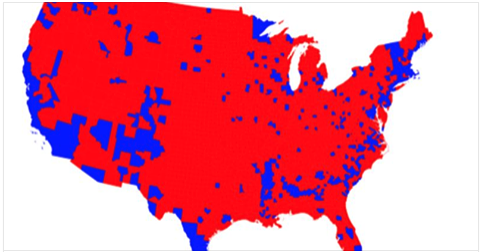
If you follow any conservatives on social media (and if you’re a liberal you really, really should) you may have come across one of the current talking points relating to the ongoing discussion about the Electoral College: maps. Such blazing red maps! Like this one:

screen-shot-2016-11-20-at-2-30-26-pm

I saw that on Facebook, linking to an article called “What Elections Would Look Like WITHOUT Electoral College” [sic], from a site called The Federalist Papers Project. Oddly—one might even say suspiciously—that article doesn’t actually include that map, though it does include this one:

electoral-college-population

That’s a map of population density; the most populated counties are in blue. “Now, if the Electoral College did not exist, what would happen to the grey counties?” the author asks. “They would be forgotten, they would not matter. Only the most heavily populated areas would be courted for votes.”

The implication, of course, is that the Electoral College is in place to protect the gray/red counties (read: Real Americans) from the decisions made by those in the blue counties (read: Kale-Munching Freedom-Haters). And there’s really only one problem with this idea:

It’s complete, unadulterated, one-hundred-percent-free-range horseshit.

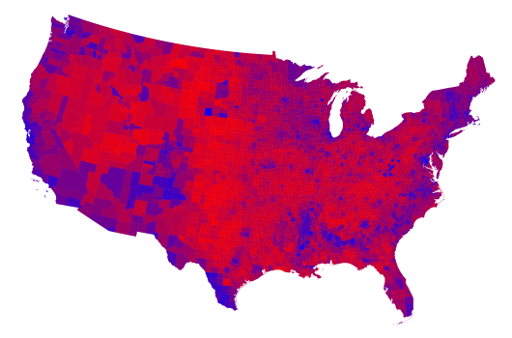
Of course, the reasons why it’s horseshit are many. First off, let’s deal with the subtext, especially the subtext of that incredibly misleading, Facebook-friendly teaser image. What the article is clearly implying is that the gray counties are actually red, which is to say conservative, while the blue counties are full of true-blue liberals. But unfortunately for the author, reality doesn’t quite agree. Here’s a map of how counties actually voted in 2016, per info available as of November 10:

countymappurple512

(Longtime readers may recognize this as being similar to the one in my Purple Nation post from 2008, and it comes from the same source. I strongly encourage you to read that whole page if you want a sense of how the country actually votes.)

Looks an awful lot less red, doesn’t it? That’s because this map uses a gradient from blue to red rather than, say, marking a county that voted 50.001 percent Republican full red and a county that voted 50.001 percent Democrat as full blue. The result? Look at all that purple! And as I said eight years ago, purple is good:

It means we have people of differing political opinions living right next door to each other. When President-elect Obama takes office in January, he should have a mural of this exact map hung in the Oval Office—a constant reminder that he’s not working for one group or another, but for everyone.

(I’d suggest Mr. Trump do the same thing except I’m not certain he knows how to read maps.)

Second, let’s look at another of the Federalist author’s implications: that since there are more non-blue counties than there are blue ones, if the blue counties get their way it’s inherently unfair. The trouble with this idea is that elections aren’t decided by counties; they’re decided by people. And if there are more people in the blue counties than elsewhere, then them getting what they want is exactly fair.

In fact, this author’s defense of the Electoral College has the issue entirely backward. The Electoral College gives those gray-or-red counties an unfair advantage over the blue ones, and here’s why: Electoral College numbers are dictated by the number of senators and representatives assigned to a state. (Plus three for D.C.) A state’s number of representatives is determined by population, but—and this is the important bit—every state gets two senators no matter the population. Therefore, states with very low populations (which tend to be rural, which tend to vote conservative) get an edge in electoral votes in comparison to the population. This is why two of the last five elections have appointed Republican presidents in spite of many, many more people voting for the Democrat. (Secretary Clinton’s lead in the popular vote is up to about three times the population of Wyoming as of this writing.)

Population numbers and math can quantify this (see here). When we run the numbers we see that 35 states have a number of electoral votes that outweighs their population (36 if you count Tennessee’s razor’s edge). Twenty of those voted Republican in 2016, bringing in 121 electoral votes for Mr. Trump, or 132 counting Tennessee. The other 15 “outsized” states brought 90 electoral votes to Secretary Clinton.

In other words, to make a very long and mathy story short, it’s the less-populated parts of the country—those gray counties—that have the unfair edge, and if the Electoral College is supposed to prevent such things from happening it’s doing a very bad job.

Finally, let’s talk about the idea, bandied about often in conservative circles and alluded to in the Federalist article, that those blue counties don’t represent “real America.” (Because why else would it be a problem for a greater number of people to have a greater impact in the electoral process?) My response to this idea will be much more succinct, I promise you, because it can be summarized in three words:

Go fuck yourself.

Real America is the immigrant with the newly minted citizenship papers as much as it is the weathered plains-state farmer. Real America is the gristly New York punk rocker as much as it is the Mississippi preacher. Real America is the newly married urban lesbians just as much as it is the suburban soccer mom. Real America is the Clinton voter just as much as it is the Trump voter, because there’s no such thing as “real” America—”real” America is America, with all its glories and failures, and you don’t get to decide who is and isn’t a “real” American.

You don’t get to decide. What you do get to do is vote, like we all do. The problem is, this year more than one in a hundred of those votes, 1.5 million and counting out of about 135 million, were ignored thanks to the Electoral College.

One hopes that the red-map-waving Electoral College defenders would feel just as strongly about this issue if they ever found themselves on the other end of this equation. But I wouldn’t count on it.